
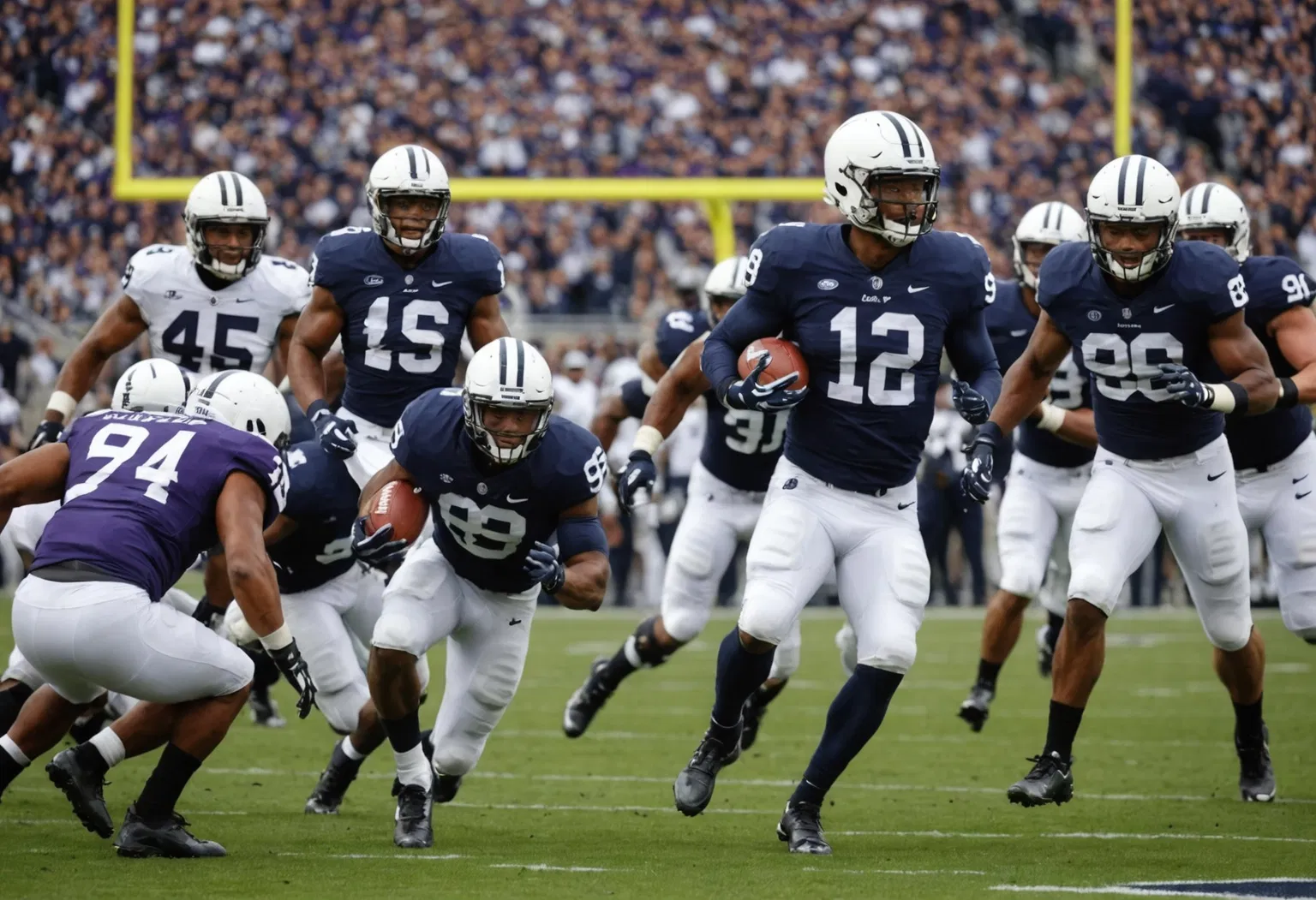
Northwestern christened its long-awaited new home in unforgettable fashion Friday night, opening the $875 million Ryan Field — exactly 100 years after the original stadium welcomed its first fans in 1926 — and celebrating by running over Penn State in a 34-13 victory in Evanston.
The final score, however, tells only part of the story. The debut of college football's most expensive stadium was a landmark evening for a Northwestern program that has rebuilt its identity under head coach David Braun, while the defeat pushed Penn State deeper into an early-season crisis in Matt Campbell's first year in charge.
Northwestern's $875 Million Stadium Opens With a Statement Night
Designed by HNTB and Perkins&Will and funded entirely through private support, the new Ryan Field replaces the 1926 facility once known as Dyche Stadium, which closed in 2023 and was torn down to make way for the modern venue. The $875 million project is billed as the most expensive college football stadium ever built, and its opening fell exactly a century after the original stadium's first game.
At 35,000 seats, the new building is the smallest in the Big Ten by capacity, yet it spans 320,000 square feet more than the old stadium. The design trades raw capacity for intimacy and premium amenities: seating begins about 90 feet from the field, an overhead canopy is engineered to trap crowd noise, and the "Wildcat Wall" gives students a European-style safe-standing section believed to be the first of its kind in college football.
Braun, who signed a contract extension through the 2031 season in mid-September, said before the opener that words could not capture the facility. After the game, he told reporters the venue "has the opportunity to become the most deafening environment in the Big Ten, in the country."
How the Wildcats Overwhelmed Penn State on the Ground
If the stadium was the headline, the rushing attack was the exclamation point. Northwestern ran the ball 54 times for 413 yards and finished with 506 total yards, leaning on a ground game that Penn State simply could not stop. The Wildcats outgained the Nittany Lions 413-48 on the ground, controlling the line of scrimmage even while playing without five starters.
Running back Joseph Himon II set the tone immediately, breaking off a 47-yard run in the first quarter to set up a two-yard touchdown keeper by quarterback Aidan Chiles that put Northwestern ahead 10-0. Himon finished the first half with 134 yards and two touchdowns on only five carries, including a 38-yard scoring run. Caleb Komolafe added a career-high 188 yards and a touchdown of his own, and the two backs combined for 350 yards and three scores on the night.
Chiles, operating a run-first offense, threw just 14 passes all game — a reflection of how thoroughly Northwestern controlled the trenches.
Timeline: From a 1926 Groundbreaking to a 2026 Rebirth
The night was the culmination of a storyline nearly a century in the making. The original Ryan Field opened on Oct. 2, 1926, as Dyche Stadium, named for William Dyche, a Northwestern graduate and former Evanston mayor who oversaw the building project. The venue eventually expanded past 45,000 seats and hosted decades of Big Ten football before closing in 2023.
Demolition began in early 2024, and by 2025 the site had become a massive excavation and construction zone. Northwestern unveiled the "Wildcat Wall" concept in May 2026 and announced Braun's extension that September. On Friday, the doors finally opened for a primetime, nationally televised game against Penn State — the first home game in the new building.
Why the Opener Matters Beyond the Scoreboard
For Northwestern, the victory validated more than a venue. Braun has guided the program to 20 wins since taking over, including 11 in the Big Ten, and his new deal keeps him in Evanston through 2031 with a reported base salary of about $2.675 million. The "why not us" mentality Braun has preached now has a physical symbol: a privately funded stadium that positions Northwestern, long the Big Ten's smallest football brand, as a destination rather than an afterthought.
For Penn State, the loss carried heavier implications. The Nittany Lions entered the season ranked in the top 15 and were still No. 13 before blowing a 17-0 lead to Wisconsin in a 24-20 loss a week earlier. Friday's defeat dropped them to 3-2 overall and 0-2 in conference play, and it marked back-to-back losses to Northwestern for the first time since 2014-15. In a program still finding its footing under Campbell, who took over after James Franklin's departure, the one-sided nature of the rushing battle raised immediate questions about the offensive and defensive lines.
"I truly believe our football team expected to win today," Braun said, before cautioning that his group is nowhere near good enough to relax after one big result.
Where Both Teams Stand Now
The victory handed Northwestern a statement conference win to pair with the celebration of its new home, and the program now carries real momentum into the rest of its Big Ten schedule. Penn State, meanwhile, sits at 3-2 overall and 0-2 in conference play, with an unsettled quarterback situation — some observers argue Alex Manske, who missed spring ball following surgery, deserves a longer look under center.
The series history now tilts toward Northwestern's recent form. Penn State still leads the all-time series 16-7 in 23 meetings, but the Wildcats have claimed the last two matchups, including a 22-21 upset in Beaver Stadium during the 2025 season.
What's Next for Northwestern and Penn State
Northwestern will look to prove the opener was no fluke when it returns to Big Ten play, with the challenge for Braun being to sustain the physical identity his team displayed while navigating a conference schedule that offers few easy weeks.
Penn State has no time to dwell on the loss. With an 0-2 Big Ten start, the Nittany Lions' margin for error has essentially vanished if they hope to remain in the conference race, and Campbell's first season will hinge on how quickly the offensive line — and the quarterback decision — can be stabilized.
The Bottom Line: Key Takeaways From a Historic Night
- Northwestern opened the new $875 million Ryan Field on Oct. 2, 2026, exactly 100 years after the original stadium's debut.
- The 35,000-seat venue is the Big Ten's smallest but the most expensive college football stadium ever built, featuring the first-of-its-kind "Wildcat Wall" student section.
- The Wildcats ran for 413 yards, with Joseph Himon II and Caleb Komolafe combining for 350 yards and three touchdowns in a 34-13 win.
- Penn State fell to 3-2 (0-2 Big Ten) in Matt Campbell's first season after a second straight loss to Northwestern.
- David Braun, extended through 2031, said the new stadium "has the opportunity to become the most deafening environment in the Big Ten, in the country."